7-TRUF
7-Truf is a trick-taking game for 4 players. The goal of the game is to make exact bids on how many tricks you will win each round. This scores you points. The player with the most points at the end of 22 rounds wins the game.
Instant play · No download
The goal is to capture or “check” your opponent’s king, backing him into a corner with no escape option. Checkmate!
2 players
A chessboard, 32 chess pieces
Board Game
All Ages
Chess is one of the best two player games out there and a classic game for a reason. The exact origins of chess are unknown, but many believe that chess evolved from a similar game in India some two thousand years ago! The game of chess that we know today has been around since the 15th century, first popularized in Europe.
Below, we will review the standard chess rules and some variations, strategies, and more.
The setup is as dictated in the picture below. The pawns act as the first line of defense, and the row behind you setup as follows: The two rooks occupy the corners, and you place the knights next to them, followed by the bishops. The Queen is placed on one of the remaining squares with the corresponding colors, meaning the white Queen is on the white “lighter” square, and the black Queen is on the black “darker” square. You then place the king on the remaining open square.
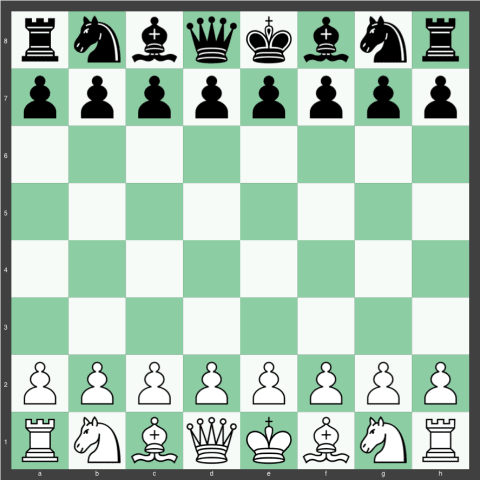 Source: http://chesssetup.com/
The game consists of a board with 64 squares of alternating colors. Each player has 16 pieces, including eight pawns, two knights, two bishops, two rooks, one Queen, and one king.
There are a lot of Chess pieces! That can feel very overwhelming when learning, but do not worry, we have the all laid out for you below.
On its first move, a pawn can move two spaces; after that, it can only move one square at a time. Pawns can only move forward unless they are in a position to capture. You can capture pieces that are one square diagonally in front of pawns but not directly Infront. They cannot move or capture backward. If there is a piece directly in front of them, they cannot move. If a pawn reaches the other side of the board, you can exchange it for any other type of piece. This is called a promotion. The pawn is the only piece you can promote, and it is usually exchanged for a queen since the Queen is very powerful.
The Rook can move any number of squares horizontally or vertically across the board but cannot move diagonally. They cannot jump other pieces, but they can capture any of their opponent’s pieces that they run into. Rooks can be powerful players when working together and can do much to protect one another.
The Knight moves in the shape of an “L,” moving two squares in one direction and then one more square at a 90° angle. Knights cannot move on the diagonal. Knights can jump over any piece that stands in its way and capture any piece it lands on.
The bishop can move any number of squares on the diagonal. Each bishop must stay on the same color square as its original starting position.
Considered the most powerful of all the pieces, the Queen has the abilities of both the Rook and the bishop. They can move any number of squares horizontally, vertically, or on the diagonal. The Queen captures any opponent piece she lands on but cannot move through pieces.
This is the most important piece of the game. It can move one square at a time in any direction but cannot move itself directly into check.
Chess is a 2-player strategy game. Learning the basics of chess may be easy, but mastering the game takes time and patience. We will review all the Chess rules you need to play the basic game below.
The age old question of every game, who gets to go first? White always goes first. Therefore, opponents should determine a fair way to decide who will be white before the start of the game. The most common way to pick who plays white first is for one player to grab a white pawn and a black pawn and jumble them up; their opponent then picks a hand randomly. If players plan to play more than one game, they must alternate colors at the start of each new game. This allows both players to have equal opportunity to take the first move, which some say can make or break the who game!
Each piece moves differently, which sounds overwhelming, but gives you a world of possibilities! Most pieces cannot move through each other but you can move them to take the place of an opponent’s piece, thereby capturing it. The exception to this rule is the Knight, which can ostensibly move “through” other pieces. Usually, you move pieces strategically to capture an opponent’s piece, defend a piece of your own, or maintain control of important squares on the board. However, you may or may not move particular pieces for numerous other reasons, so do not beat yourselves up about it if you do not. For example, you may be attempting to queen a pawn or get control of the center (of the board). Strategically, controlling the center is advantageous because many tactical battles occur there.
There are a few special rules you should know about before jumping into Chess. These are higher level moves that can really improve your chances of winning, but require a lot of forethought.
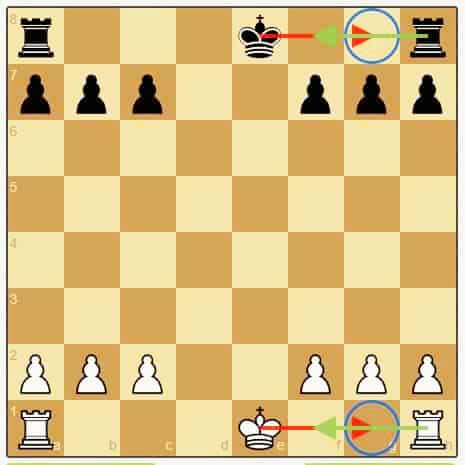 This very important rule allows you to achieve two things: your king’s safety and the introduction of your Rook into the game. On their turn, a player can move the king two spaces over toward the corner and the Rook to the right of the king. You can only do this move under the following conditions:
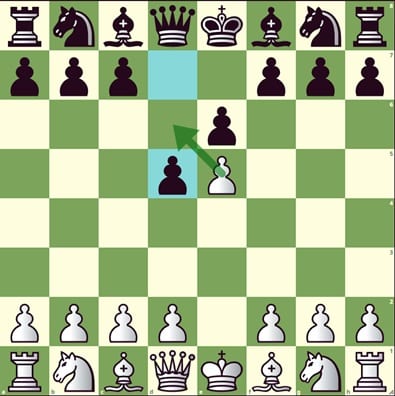 This is a special move for the pawn. When a pawn first moves, it can move two spaces instead of one. If the pawn moves two spaces forward and lands directly to the side of an opponent’s pawn, the opponent can make a special move with their pawn and capture the pawn that has just moved alongside it. To capture the piece, the pawn moves to the square directly behind their opponent’s pawn. The opponent must make this move immediately; otherwise, this move becomes illegal, and they lose the chance to capture in this way.
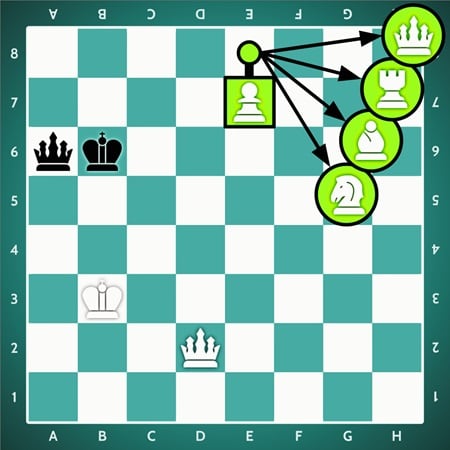 You promote a pawn by moving it across the board to the furthest line on your opponent’s side. Once a pawn reaches the back row, you can exchange it for a Queen, Rook, Bishop, or Knight. These pieces are always available for promotion, even if you have yet to lose your pieces. Most of the time, a player will promote their pawn to a queen, referred to as Queening. Turing your pawn to any other piece is considered underpromoting.
Before checkmate, you must put your opponent in check. Check means you will have a checkmate unless the opponent moves their pieces to protect their king. The king can get out of check-in three ways:
The goal of the game is to checkmate your opponent’s king. Checkmate occurs when the king is in check, and he cannot get out of it.
A game can end in a draw. There are several reasons why this can occur; below are the top three examples.
Above, we have covered the standard Chess rules. In this section, we plan to explain a couple of variations to the game you will love.
Chess Boxing brings two very unlikely sports together. This game mixes rounds of high-level chess playing with brutal rounds of boxing. Imagine trying to concentrate on your next chess move while dodging blows. It is impressive! When playing, you can win by either knockout or checkmate! However, you can also lose for excessive time or boxing fouls.
Sovereign chess is often described as one of the most complex forms of the game. The game is still for two players but played on a 16X16 board. Players will still be assigned white or black, but several other colors of pawns are lining the edges of the board. Players can control these pieces by having a piece on the same colored square on the board. Despite its differences, the end goal is to checkmate your opponent’s king.
Chess is more than a game; it’s competitive and, for some, a whole lifestyle. These people below are regarded as the top players of all time.
Magnus Carlsen is often thought ofas the best player of all time. He is from Norway and, before turning 30, had already reached the status of one of the top players. He has also reached the title of Grand Master at only 13!
Garry Kasparov was born in Russia and became the world champion in 1985. He was also the youngest to become the champion at the time, at only 22 years old! In 1996, he defeated Deep Blue, a chess computer!
Vishy Anand was born and raised in India, where he first learned to play chess from his mother at just six years old. In 1988, he became an international Grand Master and won his first major championship in 1991!
Bobby Fischer was an American-born chess player. He dropped out of school at 16 to fully dedicate himself to chess. He won the first of 8 American championships in 1958. In 1975, he ruses to meet his challenger for a championship, and his title is taken and given to his opponent. He then would not publicly play chess for the next 20 years!
Anatoly Karpov was born in Russia and became the 12th world champion, a title he held for ten years! He won over 160 first-place titles then and reached Grand Master status in 1970. He is gradually retiring from chess competitions, only playing at rapid events.
If you love chess, try out other similar games like checkers and mancala.
The most common theory is that chess was invented during the 6th century in India.
There are lots of ways for you to get better at chess. You can read strategy books, learn famous openings and games, play for more practice, or find a mentor.
A blunder occurs when a player plays a move that significantly affects their chances of winning.
A stalemate occurs when you cannot legally move but have not been placed in check. This ends the game in a draw.
7-Truf is a trick-taking game for 4 players. The goal of the game is to make exact bids on how many tricks you will win each round. This scores you points. The player with the most points at the end of 22 rounds wins the game.
65 is a new trick taking card game developed in Japan. It is played with a standard deck of cards and four players in partnerships. Players do not collect all the cards in the trick if they win which makes this a real thinker.

Five Hundred is a bidding trick-taking game. It is the national card game of Australia and a ton of fun for everyone.
5-Card Loo is a Rams card game. The goal of both is to win as many tricks as possible so you can win stakes.
5 Card Draw is an easy game to learn but a hard one to master. Here you will discover the rules to playing Five Card Draw.

4-player Xeri is a fishing card game for 4 players. The goal of the game is to score more points than your opponent by matching card ranks.
OBJECTIVE OF 7-TRUF: The objective of the game is to have the highest score at the end. NUMBER OF PLAYERS: 4 players MATERIALS: A modified 52-card deck, a way to keep score, and a flat surface. TYPE OF GAME: Trick-Taking Card Game AUDIENCE: Adult OVERVIEW OF 7-TRUF 7-Truf is a trick-taking game for 4 players. The goal of the game is to make exact bids on how many tricks you will win each round. This scores you points. The player with the most points at the end of 22 rounds wins the game.
OBJECTIVE OF 65: The first team to win 5 victory points wins the game NUMBER OF PLAYERS: 4 players NUMBER OF CARDS: 48 cards RANK OF CARDS: (low) 3 – Ace (high) TYPE OF GAME: Trick taking AUDIENCE: Adults INTRODUCTION OF 65 65 is a trick taking game played with four people in partnerships. It was created in Japan by Kuromiya Kimihiko. A card point and trick point game, teams are trying to get the most tricks as well as the most Aces, Kings, Queens, and Jacks. The numbered cards have no point value. There are a total of 65 round points possible in each round, and the team that earns 33 or more wins the round.
OBJECTIVE OF 500 CARD GAME: Reach 500 points first. NUMBER OF PLAYERS: 2 to 6 players MATERIALS OF 500 CARD GAME: Modified 43-card pack TYPE OF GAME: Card game AUDIENCE: Teens and adults OVERVIEW OF 500 CARD GAME Despite 500 being the official national card game of Australia and New Zealand, it was actually developed in the United States and copyrighted there in 1904. The game’s name is a reference to its objective: be the first player or team to reach a score of 500 points. This super fun card game is a variation of Euchre with some changes.
OBJECT OF 5-CARD LOO: The object of 5-card Loo is to win bids and collect stakes from other players. NUMBER OF PLAYERS: 5 to 10 players. MATERIALS: A standard deck of 52 cards, chips or money for bidding, and a flat surface. TYPE OF GAME: Rams Card Game AUDIENCE: Adult OVERVIEW OF 5-CARD LOO 5-card Loo is a Rams card game. The goal of both is to win as many tricks as possible so you can win stakes.
OBJECTIVE OF 5 CARD DRAW: Form the best hand and win the pot at the showdown. NUMBER OF PLAYERS: 2-6 players NUMBER OF CARDS: 52-card deck RANK OF CARDS: A, K, Q, J, 10, 9, 8, 7, 6, 5, 4, 3, 2 TYPE OF GAME: Casino AUDIENCE: Adults OVERVIEW OF 5 CARD DRAW RULES Draw Poker, or Five Card Draw, is one of Poker’s simplest and oldest forms! In fact, it was the best-known form of Poker until Texas Hold’Em became popular!
OBJECT OF 4-PLAYER XERI: The object of 4-player Xeri is to have the most points at the end of the game. NUMBER OF PLAYERS: 4 players MATERIALS: A standard deck of 52-cards, a way to keeps score, and a flat surface. TYPE OF GAME: Fishing Card Game AUDIENCE: Teens, Adults OVERVIEW OF 4-PLAYER XERI 4-player Xeri is a fishing card game for 4 players. The goal of the game is to score more points than your opponent by matching card ranks.

OBJECT OF 4-PLAYER NAPOLEON: The object of 4-Player Napoleon is to be the first player to reach a set score. NUMBER OF PLAYERS: 4 players MATERIALS: A standard 52 card deck, a way to keep score, and a flat surface. TYPE OF GAME: Point-Trick Card Game AUDIENCE: Adult OVERVIEW OF 4-PLAYER NAPOLEON 4-Player Napoleon is a point-trick card game playable by 4 players. The goal of the game is to be the first player to score enough points to win.
OBJECT OF 3-PLAYER TROEVEN: The object of 3-Player Troeven is to be the first team to reach a score of 0 to win. NUMBER OF PLAYERS: 3 players MATERIALS: A modified 52-card deck, a way to keep score, and a flat surface. TYPE OF GAME: Trick-Taking Card Game AUDIENCE: Adult OVERVIEW OF 3-PLAYER TROEVEN 3-Player Troeven is a trick-taking card game meant for 3 players. The goal of 3-Player Troeven is to decrease your score to 0 first. You do this by winning rounds. To win a round your team must score more points than your opponents.
OBJECTIVE OF 2-7 TRIPLE DRAW: Win the pot! NUMBER OF PLAYERS: 2+ players NUMBER OF CARDS: standard 52-card RANK OF CARDS: A (high), K, Q, J, 10, 9, 8, 7, 6, 5, 4, 3, 2 TYPE OF GAME: Casino AUDIENCE: Adult INTRODUCTION TO 2-7 TRIPLE DRAW 2-7 Triple Draw or Deuce to Seven Triple Draw is a lowball variant of Draw poker. In lowball poker, the lowest hand wins. There are numerous ways to rank hands in lowball poker, to learn the details of deuce to seven rankings click here and find out more on poker hand rankings.
OBJECT OF 3-CARD LOO: The object of 3-card Loo is to win bids and collect stakes from other players. NUMBER OF PLAYERS: 5 to 16 players. MATERIALS: A standard deck of 52 cards, chips or money for bidding, and a flat surface. TYPE OF GAME: Rams Card Game AUDIENCE: Adult OVERVIEW OF 3-CARD LOO 3-Card Loo is a Rams card game. The goal is to win as many tricks as possible so you can win stakes.
3D HEARTS (Double Deck Domino Hearts)
OBJECTIVE OF 3D HEARTS: Be the player with the lowest score at the end of the game NUMBER OF PLAYERS: 3-8 players NUMBER OF CARDS: 104 cards RANK OF CARDS: (low) 2 – Ace (high) TYPE OF GAME: Hand Shedding, Trick Taking AUDIENCE: Adults INTRODUCTION OF 3D HEARTS 3D Hearts is a party game style variation of Hearts intended for larger groups of people. What separates this game from classic Hearts is the use of two decks, a six card hand, drawing when unable to follow suit, and the ability for up to eight people to play.
OBJECTIVE OF 200: The objective of 200 is to score 200 points to win the game. NUMBER OF PLAYERS: 4 players MATERIALS: A modified 52-card deck, a way to keep score, and a flat surface. TYPE OF GAME: Point-Trick Card Game AUDIENCE: 13+ OVERVIEW OF 200 (Two Hundred) 200 is a point-trick game where 4 players play in two partnerships. These partnerships compete to be the first to earn 200 or more points and they complete this goal by making bids and winning tricks with card value.
OBJECT OF 2-PLAYER TROEVEN: The object of 2-Player Troeven is to be the first team to reach a score of 0 to win. NUMBER OF PLAYERS: 2 players MATERIALS: A modified 52-card deck, a way to keep score, and a flat surface. TYPE OF GAME: Trick-Taking Card Game AUDIENCE: Kids, Teens, Adults OVERVIEW OF 2-PLAYER TROEVEN 2-Player Troeven is a trick-taking card game meant for 2 players. The goal of 2-Player Troeven is to decrease your score to 0 first. You do this by winning rounds. To win a round you must score more points than your opponent.

OBJECT OF 2-PLAYER MANILLEN: The objective of 2-Player Manillen is to be the first team to score 101 points to win. NUMBER OF PLAYERS: 2 players MATERIALS: A modified deck of 52 cards, a way to keep score, and a flat surface. TYPE OF GAME: Trick-Taking Card Game AUDIENCE: Adult OVERVIEW OF 2-PLAYER MANILLEN 2-Player Manillen is a trick-taking card game for 2 players. The goal of the game is to achieve 101 points to win before your opponents.

2 PLAYER HEARTS CARD GAME RULES
OBJECTIVE OF 2 PLAYER HEARTS: The player with the lowest score at the end of the game wins! NUMBER OF PLAYERS: 2 players NUMBER OF CARDS: 28 card deck RANK OF CARDS: 2 (low) – Ace (high), hearts are always trump TYPE OF GAME: Trick-Taking game AUDIENCE: Adult INTRODUCTION OF 2 PLAYER HEARTS Hearts is a fun card game traditionally played with four players, but don’t worry! If you only have 2 players, you can still play this fun card game! Each player is trying to score as few points as possible. In this game, taking tricks is a bad thing unless you can all of them. Although it is played with a heavily modified deck, 2 Player Hearts still captures the overall strategy and enjoyment of traditional card games. Sometimes it is difficult to find four players. This two-player version makes the game a little more accessible.
OBJECTIVE OF 2 PLAYER DURAK: Be the first player to empty their hand NUMBER OF PLAYERS: 2 players NUMBER OF CARDS: 36 card deck RANK OF CARDS: (low) 6’s – Aces, Trump suit (high) TYPE OF GAME: Trick taking AUDIENCE: Adults INTRODUCTION OF 2 PLAYER DURAK Durak is an extremely popular trick taking card game in Russia. Durak literally means idiot, and it denotes the loser of the game. The game can be played with 2 – 5 players individually or in teams. The rules for a 2 player game are included below.
OBJECTIVE OF 14 POINT TUNKHANNOCK PITCH: The objective of 14 Point Tunkhannock Pitch is to reach a score of 52. NUMBER OF PLAYERS: 4 Players MATERIALS: A Standard 52-card deck, 2 distinguishable jokers, a way to keep score, and a flat surface. TYPE OF GAME: Trick-Taking Card Game AUDIENCE: Adult OVERVIEW OF 14 POINT TUNKHANNOCK PITCH 14 Point Tunkhannock Pitch is a trick-taking card game for 4 players. The goal is for your team to reach a score of 52 before your opponents.
OBJECTIVE OF ACCORDION SOLITAIRE: Stack all 52 cards into one pile by moving them if the suit or number matches. NUMBER OF PLAYERS: 1 player MATERIALS: Standard 52 card deck TYPE OF GAME: Soliatire Card game AUDIENCE: 10+ OVERVIEW OF ACCORDION SOLITAIRE Just like standard solitaire, Accordion solitaire is a deceptively tricky game that is incredibly hard to beat. Although the concept is simple, actually winning a game of accordion solitaire requires a lot of thought, strategy, and practice.
10 POINT PITCH CARD GAME RULES
OBJECTIVE OF 10 POINT PITCH: The objective of 10 Point Pitch is to reach a score of 52. NUMBER OF PLAYERS: 4 Players MATERIALS: A Standard 52-card deck, 2 distinguishable jokers, a way to keep score, and a flat surface. TYPE OF GAME: Trick-Taking Card Game AUDIENCE: Adult OVERVIEW OF 10 POINT PITCH 10 Point Pitch, also known as Auction Pitch, is a trick-taking card game for 4 players. The goal is for your team to reach a score of 52 before your opponents.

OBJECTIVE OF 10 OP EN NEER PAGE: The object of the game is to have the most points at the end of the game. NUMBER OF PLAYERS: 4 players MATERIALS: A Standard 52-card deck, a way to keep score, and a flat surface. RANK OF CARDS: A, K, Q, J, 10, 9, 8, 7, 6, 5, 4, 3, 2 TYPE OF GAME: Trick-Taking Card Game AUDIENCE: Adult OVERVIEW OF 10 OP EN NEER PAGE 10 Op En Neer Page is a trick-taking game for 4 players. The goal is to make bids and win that exact number of tricks each round. This awards you with points. The player with the most points at the end of the game wins.

OBJECTIVE OFWISH SOLITAIRE: Successfully remove all of the cards from the tableau NUMBER OF PLAYERS: 1 NUMBER OF CARDS: 32 card deck RANK OF CARDS: 7 (Low) – Ace (High) TYPE OF GAME: Solitaire AUDIENCE: Kids to adults INTRODUCTION OF WISH SOLITAIRE Wish Solitaire is a fun little way to pass the time. This game is entirely based on luck. It is believed that if you make a wish and win the game on the first try, your wish could come true! So make a wish, shuffle the cards, and give Wish Solitaire a try.

OBJECTIVE OF ELEVENS: The objective of this game is to use all of the cards in the deck to create pairs that add up to 11 in total.NUMBER OF PLAYERS: 1 or 2 PlayersNUMBER OF CARDS: A standard 52-card deck.RANK OF CARDS: Ace, 2, 3, 4, 5, 6, 7, 8, 9, 10, All royals are removed together as a trio to create their “pair”.TYPE OF GAME: PuzzleAUDIENCE: Solo players, family, friends HOW TO PLAY ELEVENS The Deal Shuffle your playing cards and deal three rows of three cards each. All 9 of these cards should be facing upwards so that they are visible. The remaining cards become the Deck for the duration of the game.
OBJECTIVE OF 5000 RUMMY: The objective of 5000 Rummy is to score a total of 5000 points to win the game. NUMBER OF PLAYERS: 3 or 8 players MATERIALS: One to Two 52-card decks, a way to keep score, and a flat surface. TYPE OF GAME: Draw and Discard Card Game AUDIENCE: 13+ OVERVIEW OF 5000 RUMMY 5000 Rummy is a Rummy style card gamer where the goal is to score 5000 points to win. Players do this by melding cards from their hands and potentially scoring points for cards left in other player’s hands as well.